How to tell the difference between jelly bean plant and Sedum Corynephyllum
9th Nov 2026 | Daniel Jackson | Sedums | 7 mins
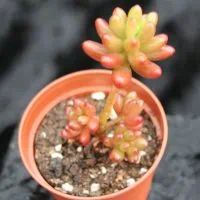
The jelly bean plant and Sedum corynephyllum are so closely related that even experienced succulent growers regularly mix them up, and with good reason: Sedum pachyphyllum (the botanical name for the jelly bean plant) and Sedum corynephyllum are either the same species under different names or near-identical siblings within the same genus, depending on which taxonomic authority you follow. The differences that do exist are subtle, and understanding them will not only sharpen your eye for plant identification but also help you care for whichever variety sits on your windowsill.
Jelly Bean Plant vs Sedum Corynephyllum at a Glance
| Feature | Sedum Pachyphyllum (Jelly Bean Plant) | Sedum Corynephyllum |
|---|---|---|
| Leaf shape | Rounded, chubby, club-like | Slightly more elongated, cylindrical |
| Leaf tip colour | Red to pink tips under stress | Red tips, often less vivid |
| Leaf length | 2–4 cm | 2–3.5 cm |
| Flower colour | Yellow | Yellow |
| Bloom season | Late winter to spring | Late winter to spring |
| Mature height | 20–30 cm | 15–25 cm |
| Taxonomic status | Widely accepted species | Often treated as synonym of S. pachyphyllum |
| Common name | Jelly bean plant, jelly beans succulent | Jelly bean plant (less common usage) |
Is Sedum Pachyphyllum Easy to Grow? (Care Guide for Jelly Bean Succulents)
Whether you are growing Sedum pachyphyllum or its close relative Sedum corynephyllum, the good news is that both are among the most forgiving succulents you can own. These plants evolved in the rocky, semi-arid regions of Mexico, so they are built to handle neglect, low humidity, and periods of drought without complaint.
That said, “easy to grow” does not mean “impossible to kill.” The most common mistake growers make is overwatering, which rots the shallow root system far faster than any drought ever would. Beyond keeping the soil on the dry side, these plants genuinely thrive with bright light, a free-draining compost mix, and minimal feeding, making them ideal for both beginners and collectors who want low-maintenance additions to a windowsill or conservatory shelf.
Looking for Sedums? Check out our Award Winning Sedums Collection
How to Propagate a Jelly Bean Succulent
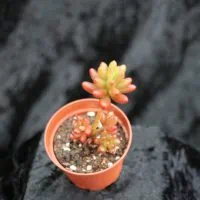
Propagating jelly bean succulents is one of the most satisfying parts of growing them, partly because it is so straightforward and partly because a single healthy plant can produce dozens of new babies with almost no effort. The two most reliable methods are leaf propagation and stem cuttings, both of which work well across spring and early summer when the plant is in active growth.
For leaf propagation, gently twist individual leaves from the stem with a clean, sideways motion, ensuring the base of the leaf detaches cleanly rather than tearing. Lay the leaves on the surface of barely moist, gritty compost in a bright spot out of direct sun, and within two to four weeks you should see tiny pink roots and eventually a rosette forming at the base. Stem cuttings are faster and produce larger plants more quickly: take a cutting of around 5–8 cm, allow the cut end to callous over for two to three days, then plant it into dry cactus compost and begin watering lightly after a week.
For guidance on importing or exporting succulents and plants, the UK Government’s plant health information provides up-to-date advice on regulations and restrictions. If you plan to grow your jelly bean collection from purchased cuttings sourced abroad, it is also worth checking the UK Centre for Ecology and Hydrol
Looking for Specialist Sedums? Check out our Rare Sedums Collection
How to Tell the Difference Between Jelly Bean Plant and Sedum Corynephyllum: Final Thoughts
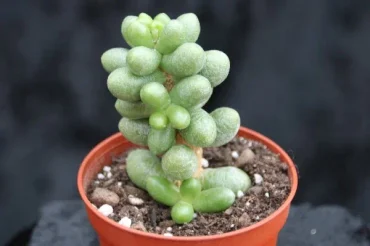
The honest answer is that telling these two plants apart requires a close eye and a little botanical knowledge, because the differences are genuinely minor. Sedum corynephyllum tends to produce slightly more elongated leaves with a less vivid red tip response under stress, while the classic jelly bean plant (Sedum pachyphyllum) leans towards rounder, plumper leaves with a more pronounced pink-to-red colouration when exposed to bright light or cooler temperatures. In many garden centres and online shops, both names are used interchangeably, so the label alone is not a reliable guide.
What matters far more than which exact name is on the label is understanding how to care for whichever plant you have, and the good news is that both species have identical needs. Bright light, infrequent watering, free-draining compost, and occasional propagation will keep either thriving for years. If you do want to be certain of the species you own, buying from a specialist succulent nursery that sources plants from reputable growers is your best starting point.
Ultimately, both plants are brilliant choices for anyone building a succulent collection. They are hardy, visually striking through the seasons, and wonderfully rewarding to propagate and share. Whether your plant is labelled as Sedum pachyphyllum, Sedum corynephyllum, or simply “jelly bean succulent,” the care advice in this guide applies equally to all of them.
- The primary botanical difference between the jelly bean plant (Sedum pachyphyllum) and Sedum corynephyllum is leaf shape and tip colouration, with Sedum corynephyllum being slightly more elongated and less vividly red-tipped under stress conditions.
- Watering is the most critical care factor: both plants prefer the soak-and-dry method, with watering every ten to fourteen days in summer and as little as once a month in winter.
- Propagation from leaves or stem cuttings is straightforward and highly successful, making the jelly bean succulent one of the easiest plants to multiply and share.
Our Most Popular Succulents
-

Ottershaw Cacti Succulent Fertiliser – Everything succulents need to flourish
£7.50Ottershaw Cacti Succulent Fertiliser - Give your plants everything they need to flourish.
Buy Now -
Aeonium ‘Jubilee’ – Award Winning Succulent Plant
£10.00Launched May 2022 at RHS Chelsea Flower Show. This lollipop-shaped plant with glorious copper...
Buy Now -
Aeonium arboreum ‘Luteovariegatum’- Tall Succulent AKA ‘Variegatum’
£10.00Awarded AGM. Variegated tall upright, freely branching Aeonium.
Buy Now -
Aeonium ‘Toffee Apple’ – Ottershaw Hybrid Succulent
£10.00A Striking compact Aeonium filled with light purple coloured medium heads with vibrant green...
Buy Now -
Aeonium ‘Zwartkop’ – Black Rose / Bold, Dark Succulent
£8.50Awarded AGM. Popular tall growing, single headed, dark leaved Aeonium
Buy Now -
Aeonium ‘Kiwi’ – Beautiful Blush-tipped Aeonium AKA ‘Dream Color’
£8.50Recently awarded AGM. A delightful hard leaved variegated bush forming Aeonium, with variegated yellow,...
Buy Now -
Aeonium ‘Pink Witch’ – Vibrant Pink House-Leek
£25.00Aeonium 'Pink Witch' has fantastic PINK colouring which she keeps all year round. Rare...
Buy Now -
Aeonium ‘Black Velvet’ – Intensely Dark
£10.00Intensely dark and matt headed Aeonium. Leaves are short and heads compact with fewer...
Buy Now -
Aeonium ‘Colossus’ – Oversized Dark Rosette
£10.00It grows BIG! Each Aeonium heads can grow 35cm+ when potted on and fed....
Buy Now -
Aeonium ‘Nights Watch’ – Award winning Succulent
£10.00Award winning, upright growing, compact, dark leaved plant that forms an unusual pyramid shape.
Buy Now


How to Tell the Difference Between Jelly Bean Plant and Sedum Corynephyllum: Frequently Asked Questions
1. Are Sedum pachyphyllum and Sedum corynephyllum the same plant?
They are very closely related and many taxonomists treat Sedum corynephyllum as a synonym of Sedum pachyphyllum rather than a distinct species. In practice, the two names are often used to describe the same plant in cultivation, with any differences being minor variations in leaf shape and colouration.
2. What is the jelly bean plant’s scientific name?
The accepted scientific name is Sedum pachyphyllum, a member of the Crassulaceae family native to Mexico. For a detailed botanical overview, the Wikipedia page on Sedum pachyphyllum covers taxonomy, habitat, and cultivation history.
3. Why do my jelly bean plant leaves turn red?
Red or pink colouration on the leaf tips is a stress response triggered by intense sunlight, cooler temperatures, or reduced watering. It is entirely normal and considered by most growers to be an attractive feature rather than a sign of poor health.
4. How can I tell if I have Sedum corynephyllum rather than the standard jelly bean plant?
Look closely at the leaf shape: Sedum corynephyllum tends to have slightly more cylindrical, elongated leaves compared to the rounder, club-like shape of Sedum pachyphyllum. The red tip response in Sedum corynephyllum is also often less vivid, even under identical growing conditions.
5. Can jelly bean plants grow outdoors in the UK?
They can be grown outdoors in the UK during the warmer months, but they are not fully frost-hardy and should be brought inside before temperatures drop below around 2°C. A south-facing spot in a sheltered garden or on a patio works well from late spring through early autumn.
6. What soil is best for a jelly bean succulent?
A specialist cactus and succulent compost is ideal, or you can mix regular peat-free compost with coarse horticultural grit at roughly a 50:50 ratio. The key requirement is fast drainage, since waterlogged soil is the primary cause of root rot in both Sedum pachyphyllum and Sedum corynephyllum.
7. How big does a jelly bean plant get?
In ideal conditions, a mature jelly bean plant typically reaches around 20 to 30 cm in height with a spreading, branching habit. Plants grown indoors in lower light conditions tend to be slightly more compact and can lean or stretch towards the light source.
8. Do jelly bean plants flower?
Yes, both Sedum pachyphyllum and Sedum corynephyllum produce small, star-shaped yellow flowers on upright stems typically in late winter to spring. Flowering is more likely when the plant receives sufficient light and a cooler, drier rest period during the winter months.
9. Is the jelly bean plant toxic to pets?
Sedum pachyphyllum is considered mildly toxic to cats and dogs if ingested, potentially causing mild gastrointestinal upset. It is advisable to keep jelly bean plants out of reach of pets and small children as a precaution.
10. How often should I repot my jelly bean plant?
Repotting every two to three years is generally sufficient, or when you notice roots emerging from the drainage holes of the pot. Choose a container only slightly larger than the previous one, as jelly bean plants prefer snug conditions and overly large pots can retain excess moisture.
11. Why are my jelly bean plant leaves falling off?
Leaf drop is most commonly caused by overwatering, sudden temperature changes, or physical disturbance, since the leaves are only loosely attached to the stem. If the dropped leaves are firm and healthy-looking, they can simply be laid on compost to propagate new plants.
12. Can I grow a jelly bean plant from a single leaf?
Yes, single-leaf propagation is one of the most effective methods for this species, with success rates significantly higher than many other succulents. Allow the leaf to callous for a day or two after removal, then rest it on the surface of dry, gritty compost and mist lightly every few days until roots and a tiny rosette appear.
13. What are the light requirements for Sedum pachyphyllum?
Jelly bean plants prefer a minimum of six hours of direct or very bright indirect sunlight per day to maintain their compact shape and vivid leaf colouration. Insufficient light leads to etiolation, where the stems stretch and become leggy as the plant reaches towards the nearest light source.
14. Do I need to feed my jelly bean plant?
Feeding is optional but beneficial during the spring and summer growing season, using a diluted liquid cactus fertiliser applied once a month. Avoid feeding during autumn and winter, as the plant is semi-dormant and excess nutrients can cause more harm than good. For general guidance on responsible fertiliser and plant care in a domestic garden context, GOV.UK’s advice on pesticides and garden chemicals is a useful reference for UK growers.